
by Eng. Maurizio Bianco
by Eng. Maurizio Bianco
Cracks in stazzi and stone houses in Gallura: causes and solutions for structural consolidation
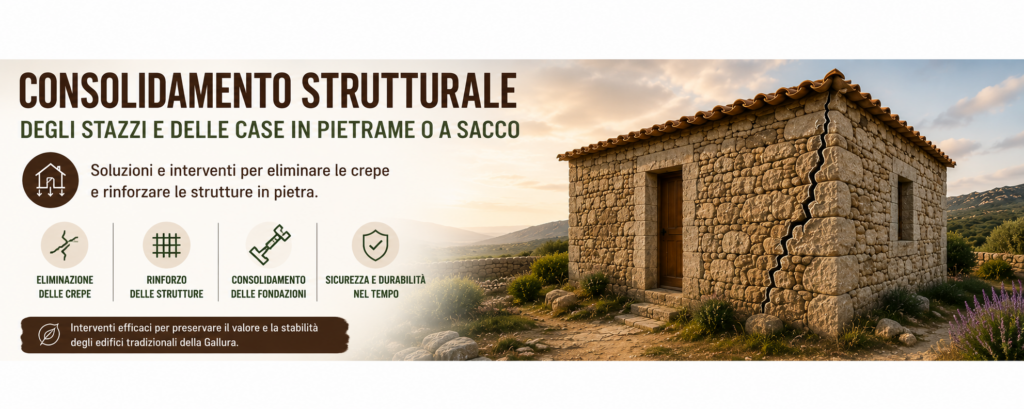
Gallura’s ancient stazzi and old stone-built dwellings represent a fundamental part of Gallura’s architectural heritage. However, many of these structures today present major structural problems due to the age of the building, the characteristics of the foundations, and ground movement.
One of the most common problems found in historic granite or “sack” masonry buildings is the appearance of very noticeable cracks, especially at the corners of the building.
Understanding the origin of these injuries is crucial to choosing the correct consolidation work, avoiding unnecessary or even damaging work.
Why cracks appear in old stone houses
In most cases, cracks that develop in the corners of buildings result from differential foundation failure.
Ancient Gallura dwellings were often built without true concrete foundations. The masonry rested directly on rubble or on simple enlargements of the wall base, adapted to the natural terrain.
Over time, they may occur:
land subsidence;
Moisture variations in the subsurface;
Erosion caused by stormwater;
Loss of consistency of old mortars;
Differential movements between different portions of the building.
When one part of the structure yields more than the other, stresses are generated that cause cracks and fissures to open.
“Sack” masonry: an ancient but delicate technique
Many old houses in Gallura are made of so-called “sack” masonry.
This construction technique included:
Two exterior stone facings;
An inner part filled with smaller stones, soil and mortar.
These masonries have high mass and good thermal inertia, but they are particularly sensitive to ground movement and water infiltration.
When masonry loses internal cohesion or foundations fail, they may appear:
Diagonal injuries;
bulges;
Out-of-plumb of the walls;
Detachments between orthogonal masonry;
Roof deformations.
Less invasive interventions: consolidate without demolishing
Not all buildings require heavy intervention. In many cases it is possible to improve structural stability with less invasive techniques that preserve as much of the original structure as possible.
Injections of consolidating mortar
One of the most widely used techniques is to perform injections of fluid lime-based mortars inside masonry.
This intervention makes it possible to:
filling internal voids;
Improve the compactness of masonry;
Increase collaboration between stones;
Reduce the risk of further detachments.
It is a particularly suitable solution in historic buildings where the utmost authenticity of construction is to be maintained.
Reinforced crack seams
When lesions are localized, reinforced seams can be used to intervene.
This technique involves the insertion of stainless steel bars or composite materials within the masonry, embedded in compatible structural mortars.
Seams make it possible to:
Reestablish the continuity of the wall;
Limiting the opening of cracks;
Improve local structural behavior.
Metal tie rods
In some cases, metal tie rods are installed to connect opposite walls of the building together.
This solution was used in ancient times and allows for:
counteracting the thrusts;
Improve the boxy behavior of the building;
Limit wall clearance.
Micropiles and soil consolidation
When the problem stems primarily from ground subsidence, less invasive foundation consolidation techniques than complete foundation reconstruction can be used.
These include:
micropiles;
expanding resins;
Localized soil consolidations.
Micropiles allow loads to be transferred to deeper, more stable soil layers, limiting further subsidence.
The most invasive but most effective interventions
In more severe cases, especially when the failure is significant or the structure has obvious deformations, more invasive structural interventions may be necessary.
This work is often essential in historic buildings where complete demolition is not possible.
Concrete foundation refurbishment
One of the most effective techniques is to build new reinforced concrete foundations under existing masonry.
The work is done by digging under the masonry in small, alternating portions to preserve the stability of the building during the work.
Next we proceed with:
Reinforcement of the new portions;
Concrete pouring;
Progressive linkage of the various sections.
This method makes it possible to significantly consolidate the structural base of the building.
Construction of a concrete summit curb
Another widely used intervention in historic stone buildings is to construct a concrete curb around the entire perimeter of the masonry.
The curb has the function of:
Connect all walls together;
Improve the structural behavior of the building;
Better distribute roof shares;
Increase the resistance to horizontal movements.
To perform this type of work, it is generally necessary to completely dismantle the existing roof.
Subsequently:
you make the curb following the profile of the masonry;
is still structurally to the existing walls;
you reinstall the roof over the new consolidated structure.
This type of workmanship is particularly suitable in historic buildings that are to be fully restored without demolition and reconstruction.
Each historic building needs a specific analysis
Old Gallura houses cannot be treated with standard solutions.
Each stazzo possesses different construction characteristics related to:
type of stone;
quality of mortars;
ground conditions;
Presence of moisture;
Changes made over time;
State of preservation of the roofs.
Therefore, it is essential to perform a proper structural analysis before choosing any intervention.
In fact, a consolidation performed without understanding the real cause of the cracks risks not solving the problem or even aggravating it over time.
Recovering a granite stazzo means preserving the building history of Gallura while improving its safety, durability and architectural value.
TWIN+
Via Cesare Battisti 6, Trinità d’Agultu e Vignola, SS, 07038 – VAT ID: 02967680907
CONTACTS
346 589 7992 digitaltwinmaster@gmail.com – maurizio.bianco1@ingpec.eu
Technical Director Dr. Ing. Maurizio Bianco
Order of Engineers (Sassari) Registration no.1674 of 26/03/2023